

Back to the seventies.
Please note that I'm going to be travelling for most of November, so posting will likely be infrequent for a while.
Before getting into today's post, you may have seen Australia's inflation figure for September, released yesterday: an increase to 4.3% (3.6% trimmed mean). Both figures are well above what the RBA would have been hoping for, so another rate hike next week is very much on the cards. As to why inflation continues to prove so persistent in Australia, let me direct you to a post I wrote back in May: Call it Jimflation.
Anyway, moving on. Have you ever noticed that bad ideas have a habit of hanging around? It's a situation not helped when the mainstream media departs from reporting into advocacy, as News Corp has done a bit too much of late. Its latest foray into policy advocacy is what it calls Back Australia, a newly relaunched and expanded campaign that's essentially protectionism dressed up as flag-waving. Here's Joe Hildebrand from an email I received this week:
"It is a matter of uncompromising reality that Australia must become self-reliant if we are to ensure our national sovereignty and economic security on a planet that is far more dangerous and unpredictable than it seemed just three short decades ago.
...
Australia must be a nation that makes things. Otherwise we will not be the nation we know."
It's true that the war in the Middle East is strangling fuel supplies, and Australia has found it more difficult to source diesel in particular. I've written about that before, and – notwithstanding the Albanese government's efforts to suppress the very prices needed to incentivise people to ration their demand – Australia has proved relatively resilient to the shock.
But sensible people could still make an argument that taxpayers should subsidise domestic refining capability. Doing so would act like an option on capacity under a tail risk scenario, and could potentially pass a cost-benefit test if that option premium is small relative to the expected loss (although a 2012 inquiry concluded the opposite because of Australia's reliance on imported crude).
The same cannot be said for News Corp's Back Australia campaign, which is more about transferring rents to incumbents than anything in the public interest. This week it cited a Westpac model from a year ago and claimed "if every family spent only $100 of their weekly household budget on Australian-made goods instead of those sourced from overseas, it would add a staggering $16 billion to the economy in just 12 months".
There are a few issues with that claim. First, Westpac (one of the sponsors of Back Australia) claimed it would add $16 billion to nominal GDP, not "the economy". Price increases could swamp the gains, in which case all you've created is a one-time increase in the price level.
Second, when an Australian household buys $100 of imported goods, the money doesn't vanish into the ocean. Some of it goes to pay the stevedores who unload it, the interstate truck driver, and the retail worker at Harvey Norman who rings it up, all of whom are based in Australia. So you've swapped a bundle of Australian and foreign jobs for another bundle of Australian and foreign jobs. Where local goods cost more, households have either bought less with their $100, or paid more for the same bundle.
Third, it's true that a locally-made good does carry more domestic value added than an imported one. But people usually buy the import precisely because it's cheaper. To get its result, Westpac is using a sleight of hand: the model counts that extra domestic value added yet omits the price premium households paid (and the foreign production it displaces, but let's assume they don't care about that, even though it might upset certain individuals).
Basically, nominal GDP goes up because Australians are paying more for the same things under a different label. It can rise while every household doing the redirecting is worse off, so it says nothing about whether the country is wealthier.
Then there's the job count. Westpac's model says around 38,000 new jobs will be created as a result of the spending reallocation. That's $421,000 of value added per job, against roughly $200,000 per employed Australian. In a demand-driven expansion, output per job should come in at or below the average, because you're pulling less productive resources into use, not more. Import-competing manufacturing at twice the productivity of the average Australian job is not a story anyone should believe!
But let's suppose for a moment that the jobs are real. Even then, they'd be a transfer rather than a gain, because you'd be propping up less competitive businesses by starving the more productive parts of the economy of the labour and capital they need to create even better jobs.
So, will Australians make the switch without government compulsion? According to Back Australia, "almost one in three Australians" were willing to pay more than 10% extra to buy local, and most Australians support more domestic manufacturing.
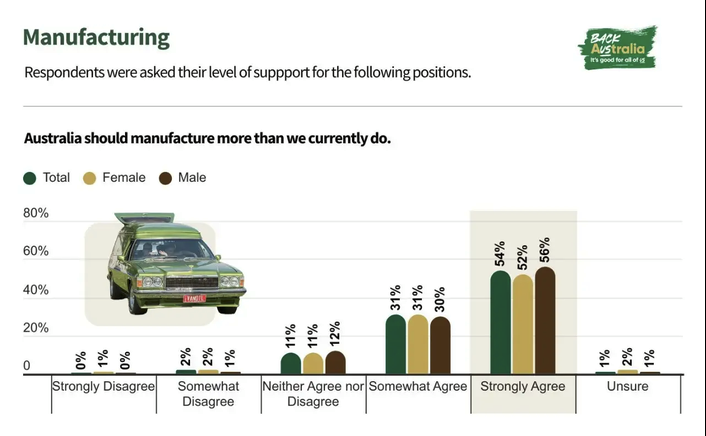
The thing about surveys is stated preferences are cheap. Actually changing behaviour at the checkout (revealed preference) is expensive. Moreover, if you read the survey's footnote, that "almost one in three" is the share of people who reported seeing the campaign, in a survey the campaign commissioned about itself.
If two in three Australians responding to a biased survey won't pay more than a 10% premium for Australian goods, that's too few shoppers to sustain the manufacturing base the campaign wants to build. Which means the inevitable outcome is that the voluntary part of the Build Australia campaign fails, and it eventually morphs into an exercise of outright rent-seeking.
That's why I'm spending so much time on this. People are unlikely to change their behaviour, regardless of how much propaganda News Corp throws at them. But there is a group that will: politicians. The last News Corp campaign, Let Them Be Kids, was a steady stream of front pages that ended in the Albanese government's Orwellian under-16 social media ban.
Campaign-as-policy has become part of the media's business model (that and subsidies), and Back Australia won't stop with asking people to voluntarily divert their own spending: it's already calling for new taxes on foreign retail giants to "boost local manufacturing". An import tax is a tariff by another name, and its costs will land on the households the campaign claims to champion.
Look, Australians will continue to make things and buy Australian, when it's actually worth doing at prices that make sense. Back Australia is trying to guilt people into acting against their own interest at the register, with the gains flowing to the shareholders of major sponsors like Harvey Norman. None of it moves Australia a millimetre closer to genuine self-reliance, which would require serious conversations about fuel storage, refining capacity, pharmaceutical manufacturing, defence industries, and so on, with strategic logic and benefit-cost analysis used to justify each dollar spent.
Trade-offs are real, and becoming "a nation that makes things" comes with a hefty price tag that should be paid with politically accountable taxing and spending, rather than hidden in regulations, tariffs, subsidies, and a series of off-budget "investment" vehicles like the National Reconstruction Fund.
Back Australia, by contrast, is nothing but rent-seeking in the form of recoloured 1970s industrial policy, and it keeps coming back because someone's income depends on it. In this case, look no further than the sponsors, the bank that built the model, and the politicians who get to sell an existing policy package (Future Made in Australia) as though it were a response to public demand.
Related
Subscribe to the newsletter.
Get new essays delivered to your inbox. No spam. Unsubscribe anytime.