

Canada should open up.
Late on Friday, what earlier in the week looked to be promising trade talks between Canada and the US suddenly broke down. The US government immediately imposed 50% tariffs on $20 billion worth of Canadian goods, while Canada's Prime Minister Mark Carney said his country was now "at war", and that it would retaliate with "dollar for dollar" tariffs.
Carney absolutely made the right decision to walk away from the "deal". At the last minute, the US apparently attempted to strip Canada of its trade sovereignty by blocking it from making deals with other countries, while also requiring it to drop Quebec's French-labelling rules for American products.
But was a "dollar for dollar" tariff retaliation the right move? I'm no politician, and perhaps it was the best political move: emotion tends to 'trump' reason in these situations, and the politician's syllogism probably leads Carney towards the simple, clear, direct "something" in response. Retaliatory tariffs will also inflict at least a bit of short-term pain on a swath of American firms, workers, and consumers, which might cause Trump some political pain ahead of the November mid-terms, and damage the chances of his successor (Vance?) at the next election.
But retaliation also imposes more pain on Canadian firms, workers, and consumers, at a time when the Canadian economy is already struggling. In fact, it'll almost certainly hurt the average Canadian more than the average American because the burden lands on 40 million Canadians rather than 340 million Americans. Canada is also a lot more dependent on trade with the US than the other way around, and its exporters have few alternative buyers, so they'll eat much of the US tariff through lower prices and thinner margins. When Canada retaliates, Canadian consumers will likely pay most of that bill, too, because of a lack of substitutes for American goods.
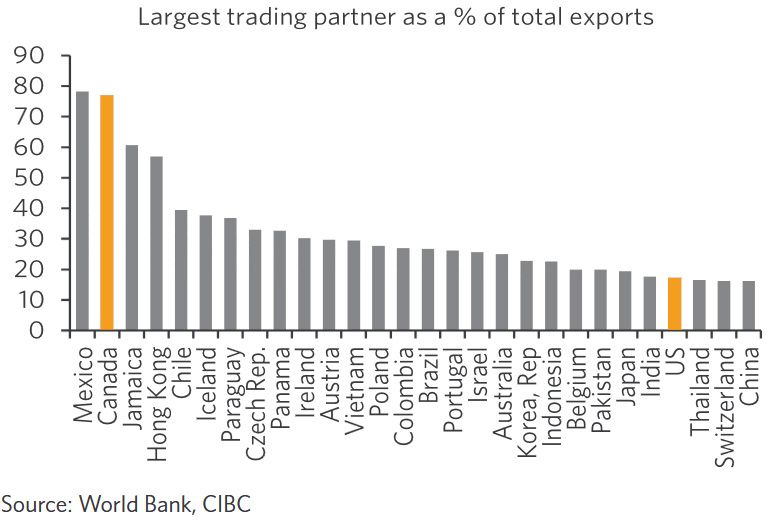
So what should Carney have done? This whole saga struck me as a golden opportunity for Carney – an economist by training, remember – to make the case for opening up Canada's sclerotic economy.
Vincent Geloso, an assistant professor of economics at George Mason University, has been arguing that Canada is no champion of free trade. While its tariff levels are low, it is still "significantly protectionist", choosing to erect barriers to trade through the dark arts of non-tariff barriers and barriers to freedom of service provision.
In response to the "war" with the US, Carney should immediately start removing those barriers, which would boost productivity growth and attract investment, which has been sorely lacking in Canada over the past decade. He should also tear down Canada's internal barriers to trade, which the IMF earlier this year estimated are equivalent to a 9% tariff. Simply removing those could lift Canadian GDP by nearly 7%, or about C$210 billion, over the long run.
The fact is there's a serious lack of competition in Canada's economy, largely because the government protects its favoured oligopolists from airlines to telcos. That has dragged on Canada's productivity (and driven up prices for consumers) for decades. But it's also an area ripe for reform; low-hanging fruit that Carney can pick to lift growth during turbulent times, provided he's willing to break the coalitions of rent-seekers that profit from the present arrangements.
So, my advice to Carney, not that he wants it, would be: by all means retaliate against Trump's tariffs. For a politician, an emotional 'tough guy' response is probably the best course of action if you want to keep your job. Retaliation also keeps a chip on the table for when talks resume; the barriers mostly tax Canadians, so dropping them concedes nothing.
But Carney should also be using the chaos as political cover to tear down some of the self-inflicted internal and external barriers to trade that have kept Canadians poorer than they need be. He can do that completely independently of the negotiations with the US, using it as a pro-growth agenda to offset some of the negative income effects that heightened tariffs will inevitably produce.
Will he, though? I'm not so sure. Carney the economist knows what to do. But Carney the politician answers to the dairy lobby, the telcos, and Air Canada's shareholders, and they don't care what he used to know.
Related
Subscribe to the newsletter.
Get new essays delivered to your inbox. No spam. Unsubscribe anytime.