

Chalmers' dangerous obsession.
Jim Chalmers has been Australia's Treasurer for more than four years. That's enough time to get some pretty good ideas about how he might view the world and, more importantly given his role, the economy. And one thing in particular stands out: Chalmers is a man who fundamentally dislikes capital, because he appears not to understand its importance in achieving the goals he claims to want.
That's pretty clear through his legislative actions, such as his capital gains tax changes, his long essays on "values-based capitalism", and also his tweets. On the latter, Chalmers recently decided to cherry pick some data from the June national accounts that:
"...show that workers' share of national income is the highest in a decade. More than half of national income now goes to workers, under Labor. Under the Liberals and Nationals it was less than half."
There are a few issues with that statement. The least problematic is what's addressed by the various community notes attached to it: to make his claim, Chalmers is cherry picking the 2022 low when the wage share of income was briefly under 50%, largely due to a temporary surge in mining profits. Strip that out, and the labour share has been above 50% and broadly stable for decades.
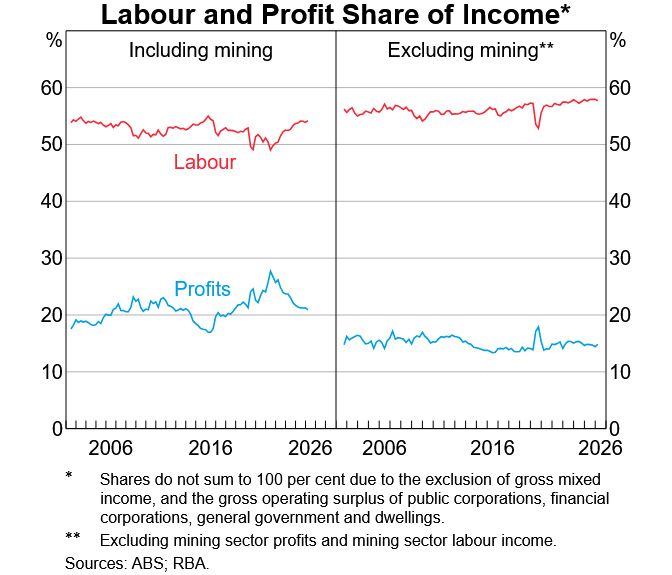
But the more problematic issue is that Chalmers is concerned about the wage share of income at all. Economist Warren Hogan commented that:
"This appears to be a policy target. In which case we need to understand how they are going to maximise this ratio. Undermining profitability is one way to drive up the wage share. Not sure it is an optimal path for our community. Others will clearly disagree."
It's a good point. As Hogan notes, there are ways to drive up the labour share of national income that aren't necessarily in the interest of the nation. For example, you could pass industrial relations regulations that raise the cost of hiring and reduce profits. You could raise taxes, add layers of red tape, or embark on industrial policy to channel capital to less productive sectors, all of which will reduce investment and profits, boosting the labour share.
You could expand the public sector, which doesn't generate profits, mechanically pushing up the labour share regardless of whether workers are better off. You could expand the non-market sectors of the economy, which tend to be lower-productivity (e.g. NDIS) and hence will also drive up the wage share, even if it leads to a smaller income pie and lower average real wages.
It's easy to boost the labour share of income by reducing, or slowing the growth rate of, national income. The wages share of income will go up, but the amount of wages being pocketed by workers will be less than in a world with more national income and a smaller wages share of that income.
In other words, the labour share of income tells you very little about the welfare of workers. Consider that the highest labour share of income in the world can be found in Nigeria (75.2%), followed by Switzerland (70.4%). What policy conclusions should be drawn from that? What Chalmers should be tweeting more about is national income, which has not been doing well under his stewardship.
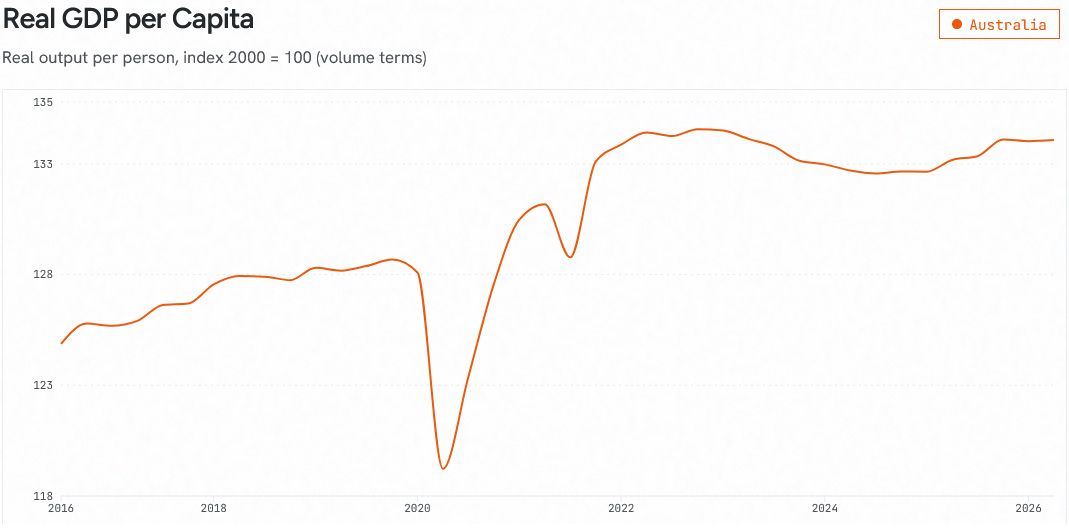
If you want to help workers, the policy goal should be raising productivity and real wages, which is not in conflict with a falling wage share of income. In fact, a falling wage share of income could be desirable in a world with rapid technological change where capital is free to accumulate (as capital becomes more abundant it competes away its own returns, with the gains flowing to workers).
Alex Tabarrok, an economist at George Mason University, recently ran a useful thought experiment. If AI raises annual GDP growth to 5%, the economy is roughly a third larger after ten years than it would otherwise have been. Labour's share can drop from 60% to 45% and workers, in aggregate, earn exactly the same as they would have without AI. At 10% growth, labour's share can fall all the way to 28% without reducing aggregate labour income. As he concludes, "growth is a good problem to have", because if society isn't happy with a lower wage share of income in a high-growth economy, making workers whole is surprisingly affordable.
But to get to a high-growth economy requires a Treasurer who isn't obsessed with the supposed conflict between labour and capital, and who hasn't pre-committed to defending the wage share of income as some kind of policy target. Because a country with such a Treasurer will be tempted to tax, regulate, or obstruct the very technology and capital accumulation that makes the pie bigger, reducing national income and leaving workers worse off.
About the author
Justin Pyvis
Independent economist and casual techie based in Perth, Western Australia.More →
Related
Subscribe to the newsletter.
Get new essays delivered to your inbox. No spam. Unsubscribe anytime.