

Competition is a tough weed.
Justin Pyvis · 20 August 2026
The emergence of large language models (LLMs), more commonly known as artificial intelligence or AI (I disagree that they're genuinely "intelligent" but that's for another day), poses a basic test for market competition.
The current market for AI is relatively concentrated, dominated as it is by two players, OpenAI and Anthropic. According to payments data, as at the end of July those two private companies accounted for more than four in five US business subscriptions to AI models.
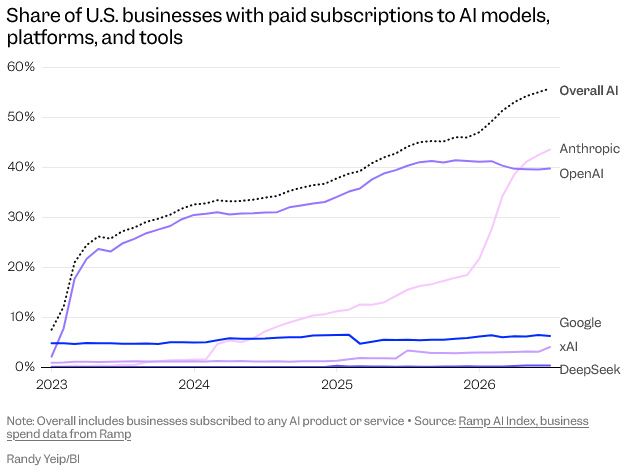
OpenAI and Anthropic are no doubt relying on their market share and impressive revenue growth (although it's easy to sell dollars for cents!) to juice what they hope will be highly lucrative public offerings later this year (Anthropic) and in 2027 (OpenAI).
But how sustainable is that market share? There's no competitive moat for these companies, other than "Buy USA" and know-your-customer type rules and mandates that may eventually flow from the government, forcing people to use them. While it's true that the immense capital required to train frontier models works as something of a moat, it never holds for long. Every time OpenAI or Anthropic releases a new frontier model, an open-weight Chinese model built on second-tier chips follows weeks later with comparable benchmarks at a lower price point. Kimi K3 and GLM-5.3 might not be quite as good as Claude Opus 5, but they cost much less per task.
The fact is LLMs are rapidly commoditising; I can't speak for anyone else, but when I'm working I generally just use the model that offers the most value (intelligence / price) for the job at hand. For relatively simple tasks that might be DeepSeek V4 Flash or Gemini 3.7 Flash; for more complicated work, perhaps it's GPT 5.6 Sol or GLM-5.2.
My point is I'm largely indifferent to the owner of the model, and it's relatively straightforward to avoid using models hosted in certain jurisdictions. I have no brand loyalty; I just do a quick price check, fire up OpenCode, and use what's best for the given situation. While I still use closed models occasionally, I try to avoid doing so because the firms that own them seem intent on actively making them worse.
I understand that's probably not the normal use-case. Perhaps most users just pick a well-known provider of a model, such as OpenAI or Anthropic, and stick with it. If they can lock-in enough of those people, then maybe that's good enough to turn today's losses into tomorrow's profits and justify trillion-dollar valuations.
But I'm not so sure. The early evidence suggests that even people with subscriptions to the big two aren't exactly loyal; around 79% of Anthropic's business customers also pay OpenAI.
Then there's the new competition at home. Not just SpaceX's Grok, Google's Gemini, or Meta's Muse, but from what are known as aggregators. Stripe will reportedly acquire OpenRouter, which is basically an API through which you can use any LLM. For those not aware, Stripe is like a better version of PayPal whose software sits behind a large share of online checkout forms.
Stripe could use its expertise in that area to also become the best aggregator of LLMs, optimised for the customer. In effect, they'll do what I do semi-manually, automatically: choose the right model for your task to maximise value, without you having to shop around. Even if the LLM being used is still Claude or GPT, most of the value would accrue to the aggregator, not the model's owner.
The only way I see OpenAI and Anthropic staving off the competition is with a government-provided moat or by creating products that utilise their models in a way to lock users in. That could be partnerships with firms that already have products, or it could be something entirely new. But building desirable products is considerably more difficult than hosting an LLM, so there's no guarantee they'll be able to pull it off.
George Stigler, the 1982 winner of the Nobel prize, once observed that "competition is a tough weed, not a delicate flower". No matter how concentrated or monopolistic an industry appears, the threat of entry tends to ensure that the measured impacts on prices and output often don't differ much from those in industries with lots of firms competing.
OpenAI and Anthropic are dominating in terms of LLM market share right now, but that doesn't mean they're not operating in a competitive market that can quickly send them bankrupt. Their hoped-for trillion-dollar valuations are unlikely to eventuate (or will evaporate!) if they're not able to capture monopoly rents, an unlikely task given the constant threat of users routing to cheaper models. They're growing revenue by cutting prices, but revenue is not margin, and the hefty model training and data centre construction CapEx bill doesn't shrink with token prices.
In other words, OpenAI and Anthropic are just as likely to go the way of 19th century railroad owners as they are to "win" the AI race, which may be unwinnable in the context of having a few dominant firms, rather than a sea of models that can be plugged into competing aggregators.
It's going to be fascinating to see how this one plays out.
Subscribe to the newsletter
Get new essays delivered to your inbox. No spam. Unsubscribe anytime.