

Cricket Australia's quiet life.
Justin Pyvis · 18 August 2026
Australian cricket is in a bad way. The men's Test team just convincingly lost to 9th-ranked Bangladesh on home soil, for the first time ever. For context, there are only 10 ranked teams, and prior to this tour Bangladesh lost to the bottom-ranked Zimbabwe by an innings and 85 runs. The invitational Cricket Australia XI also rattled Bangladesh just five days before the first Test, rolling them for a measly 54 runs in their second dig to win by an innings and 38 runs.
Full credit to Bangladesh; they did play well. But they weren't great, the Darwin wicket wasn't doing anything too unusual, and this defeat says more about the state of Australian cricket than Bangladesh.
I don't think this is quite Australia's Ashes moment; Bangladesh won't consistently match Australia head-on any time soon. One loss doesn't kill a strong cricketing nation like Australia, but complacency about what caused it can rot one.
Australian cricket's monopoly problem
Cricket Australia (CA) is a bit like FIFA in the sense that it holds a local monopoly over top-level cricket. It faces competition from other codes for talent and attention, but cricket truly dominates the Australian summer.
That means the feedback loop that punishes bad decisions can be slow; CA's decision-making can become sclerotic, yet no heads roll because there's little immediate damage to the metrics tracked by the Board. Bad decisions then compound instead of being corrected.
The exceptional talent available in Australia papers over it for a while until, one day, the insulated team of selectors led by a former player who is far too chummy with the squad's elder statesmen picks the oldest Test XI since 1928, and Australia suffers a humiliating loss.
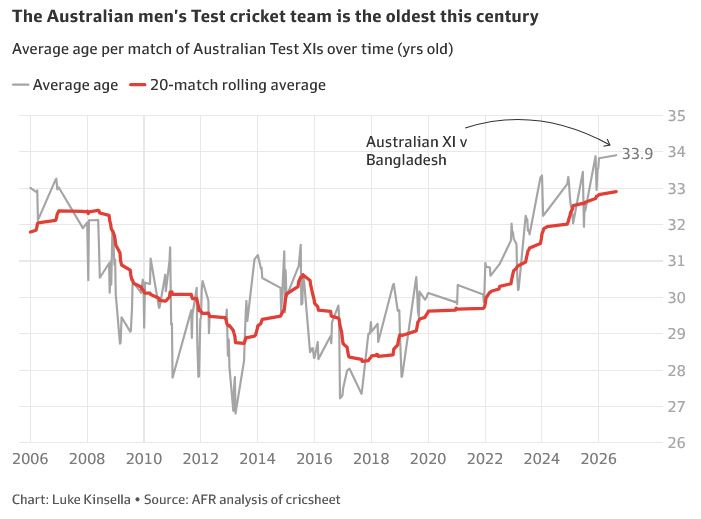
Australia's selectors in the 1928–29 Ashes were just as loyal to an ageing post-WWI generation (they even dropped a young Don Bradman!), keeping talent out until the series collapse finally forced an injection of youth. And I mean forced: the selectors who dropped Bradman were reportedly so vilified that they "contemplated changing their names by deed poll".
The rot starts at the head
A monopoly sporting body doesn't guarantee rot, but it does guarantee that rot faces little external discipline once it sets in.
Today's rot begins with George Bailey and the CA board who appointed a then 38-year-old as chief selector in 2021. Bailey is too close to the current squad, having played top-level cricket with or against every single member of the side that lost to Bangladesh.
Bailey is why the Australian XI has continued to age. He was so close to former stalwarts such as Usman Khawaja that the opener once managed his workload through a personal plan with Bailey, over the heads of Queensland's medical staff, who had cleared him to play. That's how a player in decline kept his spot despite an average of 31.4 after the 2023 Ashes, one century in his final 51 innings (a flat-track double against Sri Lanka), and a sole fifty in his final 17.
Australia will probably beat Bangladesh when they play again in Mackay on Saturday. The talent gap is real, and wounded pride is a great motivator. But that would be the worst result for Australian cricket because it allows Bailey to file the loss under "one bad week" or "early season rust", and the feedback loop slows a little more.
The problem with that is the Test schedule is about to get very tough. After Bangladesh, the Australian men have three Tests in South Africa against the reigning world champions, four at home to New Zealand, five in India, a 150th anniversary Test against England at the MCG, then an away Ashes series. All up, that's 19 Tests in eleven months for a side with one player aged under 30 (Cam Green, Australia's sole centurion against Bangladesh), and backups such as Scott Boland who are already on the wrong side of 35.
As I see it, there are two options for selectors from here: inject youth now, or wait for a humiliating series defeat to force their hand, the way it was in 1928–29.
To be sure, youth doesn't guarantee a quick payoff. Young players fail, especially when you expect them to perform consistently from day one. A recent example is opener Sam Konstas, who at 19 was parachuted into the Boxing Day Test against India, dropped after the next Test, only to be suddenly recalled for a tour of the West Indies months later in tough batting conditions. Needless to say, it didn't work out for the poor fella. Blooding youth while your ageing stars still have some good years left is critically important, but you have to back them: Steve Waugh took four years and 26 Tests before he finally scored his first Test century.
Delaying a refresh might buy CA a bit more immediate success, but it leaves a bigger bill for the future. In January 1984, Chappell, Lillee and Marsh retired together at the SCG; asked why, Marsh said "because all my mates have gone". Australia spent the next five years getting beaten while the new side found its identity, and didn't win the Ashes again until 1989.
That's the risk Australia now faces. Bleed a little now, on your own terms, or all at once later on someone else's.
It's time for reform
Bailey and CA have refused to budge because of the incentives they face. For Bailey, he's supporting his mates while also notching up wins (at least until last week), which is what's most likely to get his contract extended. Why jeopardise his high-status and presumably well-remunerated post, upset his friends, and risk the odd loss, all so his eventual replacement can enjoy the fruits of a refreshed squad?
For CA, an eventual summer of heavy losses costs almost nothing: no relegation, no rival supplier, and a public that will watch regardless. Why force the issue when the wins are still rolling in?
The late Nobel laureate John Hicks once quipped that "the best of all monopoly profits is a quiet life". Raw talent has bought CA that quiet life for decades, but preventing another 1928, 1984, or 2026 requires governance reform to inject competition into CA where there is none. I don't know what form that might take, but contested selection, fixed terms for selectors, and a succession plan for every player over 33 would be a good start.
Subscribe to the newsletter
Get new essays delivered to your inbox. No spam. Unsubscribe anytime.