

Higher for longer.
If the Reserve Bank of Australia's (RBA) cash rate is close to record highs, then why are Australian households still spending like it isn't (6.8% annual spending growth in August)? That was the "puzzle" recently put to Deutsche Bank's Lachlan Dynan in the AFR, and I found his answer somewhat unsatisfactory.
According to Dynan, Australians are a lot wealthier than they were when the cash rate was last at this level in 2011. The result is that net interest and dividend flows now drag on household income by about 1% of disposable income, against roughly 3% back then.
Basically, higher mortgage payments are being offset by interest income and dividends. Super balances rose $231 billion in the last quarter, shares by $36 billion, and housing fell 'only' $29 billion. So the wealth channel is being cushioned too, "as the artificial intelligence boom keeps global stock indices marching higher".
Put it all together, and the AFR concludes that "interest rates will need to stay higher for longer to quash the persistent inflation pressures dogging the economy".
Dynan and the AFR are half right in that the transmission of monetary policy is indeed weaker than it once was, for the reasons cited. But they then make the mistake of reasoning from a price change: the cash rate level tells us precisely nothing about the current stance of monetary policy. If it did, money would be tight in places like Argentina (cash rate 29%), despite inflation running at an annual rate of 33%.
By most reasonable indicators, monetary policy in Australia has in fact been relatively loose since the pandemic, despite the cash rate now at its highest level since 2011. My favourite indicator is the GNE deflator, which has been hovering around 3% for a year – well above the ~2% it averaged in the decade before the pandemic.
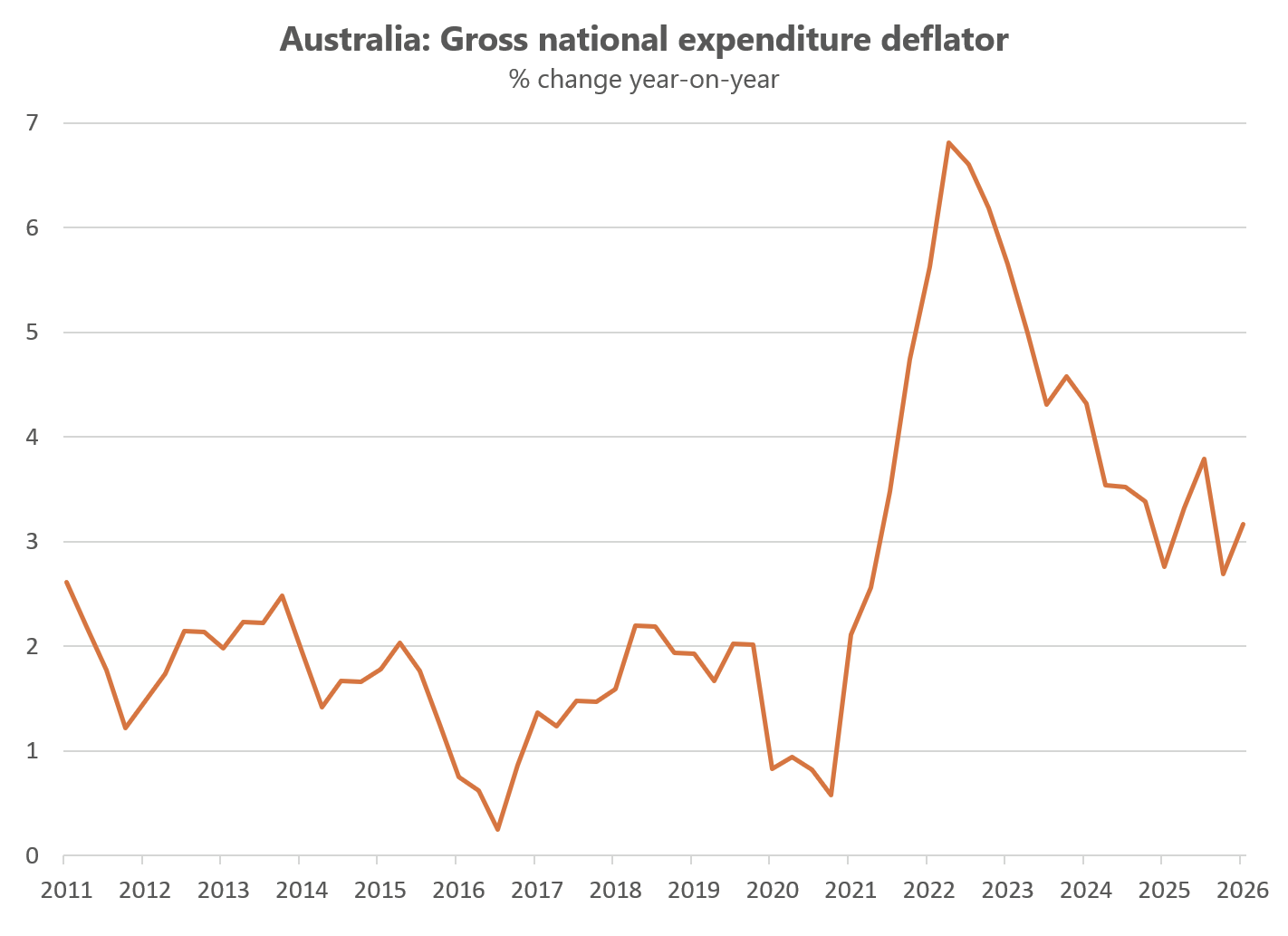
A GNE deflator growing at 3.2% against a 4.6% cash rate implies a barely restrictive real rate of 1.4%. If the neutral rate has risen on the back of AI capital expenditure, energy investment, and persistent government deficits (annual federal spending has been growing at an average real rate of 4.2% over the past three years), then even that thin margin is likely thinner still. Add in the Fair Work Commission's 4.75% wage award decision (6% for the lowest-paid) that landed on 1 July while labour productivity goes backwards, and the margin all but evaporates.
Unless Australia's governments cut the growth in their debt-funded spending by a couple of percentage points a year, the cash rate looks set to be higher for longer, because at its current level, monetary policy is clearly just not that restrictive.
Related
Subscribe to the newsletter.
Get new essays delivered to your inbox. No spam. Unsubscribe anytime.