Safety is the new censorship.
The Australian government's latest social media bill is about giving people the "choice" to opt out of algorithmic feeds. That's the sales pitch, anyway, and it probably sounds perfectly reasonable to the average punter. But a quick look at the bill itself shows that it does so much more.
First, "the algorithm" is never properly defined, which is a serious issue. The bill also grants the eSafety Commissioner powers the government is actively taking away from Australians – you know, like creating anonymous social media accounts, generating AI content, and interacting with users, all without disclosing that they're government-operated. These new powers would be fully under the control of the eSafety Commissioner and the Communications Minister of the day, with little to no Parliamentary oversight to keep them accountable:
"As we worked through the many tweaks and additions, what emerged was a case study in how protection can become a pretext for surveillance and control. In its full context, even the promised increase in user choice begins to look like a Faustian bargain, where Australians are asked to grant open-ended ministerial powers in exchange for a feature that some platforms already offer."
This would be extraordinary legislation if there were well-documented harms being caused by social media companies. But there really aren't; you have largely vibes-based evidence of harms inspired by Jonathan Haidt's scientifically-dubious but emotionally-charged Anxious Generation coming up against a growing body of empirical evidence that doesn't find much harm, if any, once other factors are taken into account. Social media also has benefits, which are never cited by the the Albanese government's various statements on the issue.
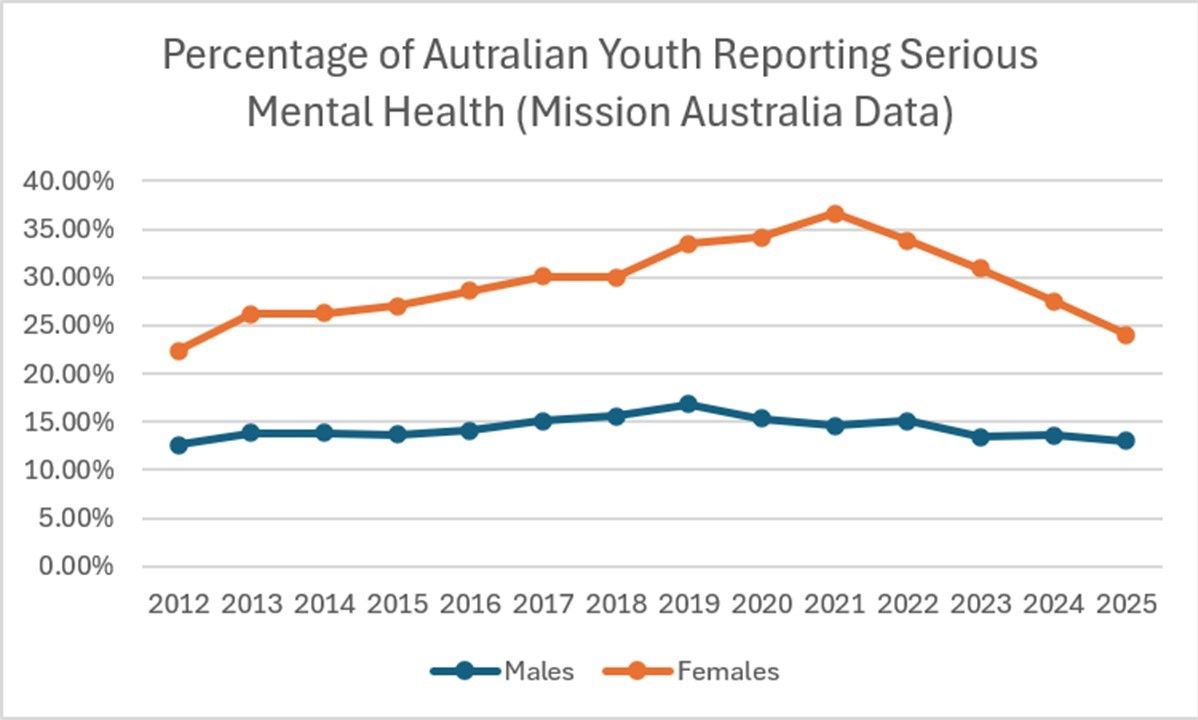
In Australia, recently-released data on serious mental health reports among young people show a decline that shouldn't be possible if what the Albanese government has been saying is true (the downward trend for female youths started well before the under 16 social media ban).
The Albanese government recently acknowledged there's no actual evidence of harm or that its heavy-handed response will work, then simply doubled down:
"Uncertainty about causation should not delay action to protect young people. The existence of credible risks of harm and credible causal pathways between account-related design features and those risks justifies the parliament's decision to enact a precautionary protective measure before scientific consensus establishes that it will be effective."
It's essentially arguing that the precautionary principle trumps the harm principle. I disagree in this case, largely because there's a lot of evidence suggesting no causal link, or at best an inconclusive link, between social media and youth harm. But I also disagree because history is littered with examples of governments claiming powers for various reasons, including safety, only to use those powers for political reasons (the 2015 Mandatory Data Retention Scheme springs to mind). In this case, the bill grants what is essentially unchecked power to control online speech, which will be too tempting not to abuse.
In my view, the threat of government overreach and the erosion of what free speech we have left in Australia is much more dangerous than the vague, unproven risks of social media, and so the precautionary principle should be applied to that.
Look, maybe social media does impose net costs on society. But the considerable empirical uncertainty should give any policy maker interested in harm prevention pause before supporting what are essentially censorship laws that could open a Pandora's box of harmful consequences for Australians.
Related
Subscribe to the newsletter.
Get new essays delivered to your inbox. No spam. Unsubscribe anytime.