

Should FIFA sell equity in the World Cup?
Justin Pyvis · 6 August 2026
Last week FIFA's President, Gianni Infantino, announced plans to sell an equity stake in the World Cup. The reactions were swift and almost universally negative, with at least 96 member countries either formally rejecting the plan (UEFA and CONCACAF), or condemning the approach (AFC). UEFA even went as far as to announce a boycott of all FIFA competitions, which was pretty awkward given that the next World Cup is due to be held in two of their member countries.
The pressure was clearly too much and as of Sunday – just days after revealing it – Infantino had abandoned the plan.
But while the idea might be dead, it did get me thinking about the why: Both why Infantino wanted to deal a stake to private equity, and why everyone was so opposed.
A non-profit cartel
FIFA the organisation has operated as a non-profit association under Swiss law since 1904. In practice, it operates as a global monopoly cartel. Its core function is selling the broadcasting and marketing rights to the World Cup, which generates billions in revenue every four-year cycle. In the 2022 cycle it raked in what was at the time a record US$7.5 billion, and is expected to have doubled that to US$15 billion in the 2026 cycle.
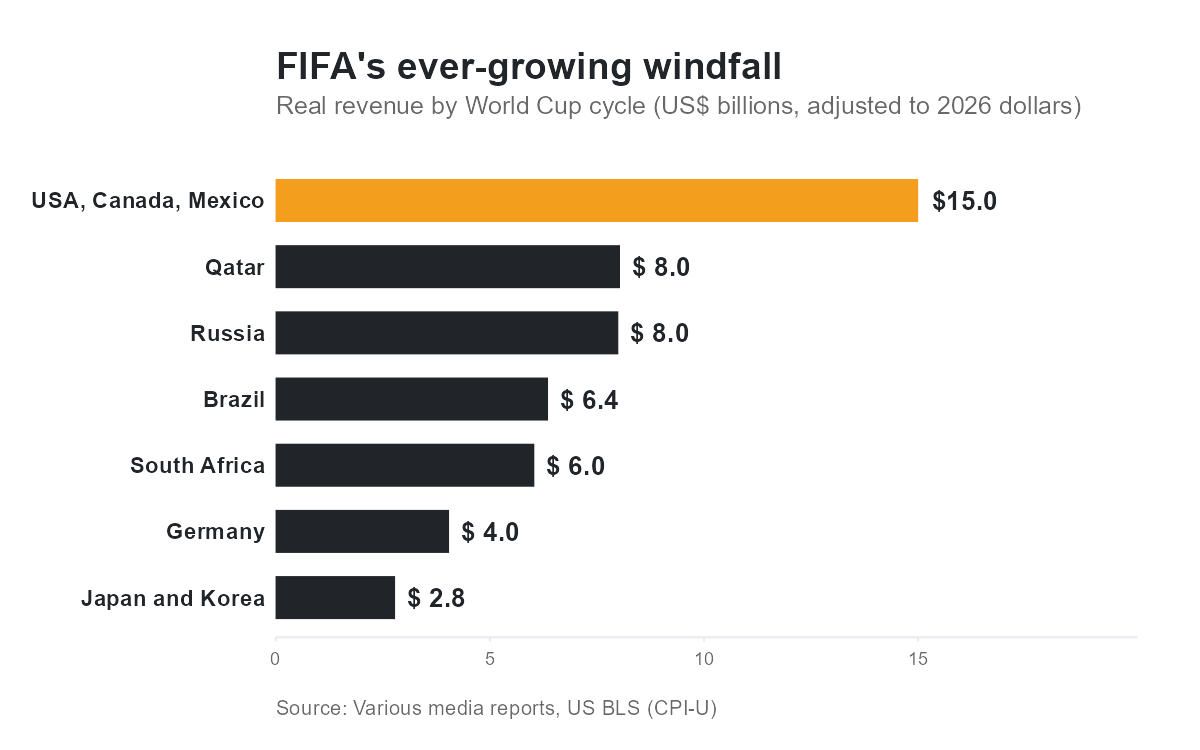
It has costs, of course, but they pale in comparison to such windfalls. As a non-profit, that surplus must be distributed to the cartel's 211 member associations and six continental confederations. That money is the glue that holds the cartel together, but it's the 1 member, 1 vote governance structure that opens the door for corruption: developing federations with little to no independent revenue sources are entirely reliant on FIFA, which effectively buys their votes with the additional funding (and not always in the most savoury manner).
The richer federations mostly tolerate what basically amounts to corruption because the World Cup's massive revenue is guaranteed income for them. Even if they wanted to change it, they wouldn't have the votes to act: there are 211 possible votes, giving Asia (47), Africa (54), and Oceania (13), composed of many cash-strapped nations, an absolute majority. Add in the 41 CONCACAF members, most of which are from developing nations in Central America and the Caribbean, and the incentives align to create modern-day FIFA.
That's why no matter who is in charge at FIFA they always seem to come across as corrupt, although Sepp Blatter (1998-2015) and now Infantino (2015-) have certainly taken it to another level.
Rugby's cautionary tale
Selling equity in sports teams isn't new but it's usually a symptom of financial distress, which is hardly FIFA's situation. A good recent example comes from rugby, when in 2023 the financially strapped New Zealand Rugby closed a long-debated deal to sell a minority stake in the commercial rights to the All Blacks for roughly NZ$200 million. Private equity firms have also bought stakes in European rugby, and were reportedly interested in buying part of Rugby Australia.
The pitch is always the same, and unfortunately, the result often is too. Some upfront cash to grow the game, sure, but private equity isn't a charity. They extract value, optimise for short-term cash flows, and have a tendency to saddle their acquisitions with debt. The whole process also introduces a massive conflict of interest between profit-maximising shareholders, the often-inexperienced management of the day (all-too eager for up-front cash to pay their bills or finance pet projects), and the fans who want the game to grow from the grassroots.
In the case of NZ Rugby, an independent governance review found that the board used a flawed process to evaluate the sale, and there was a general lack of corporate capability. The deal gives the private equity partner a guaranteed 7.5% of all revenue, while NZ Rugby remains fully responsible for the rising costs of running the game. The risks to the future of the game are so great that the current board is investigating whether it can buy the share back with a new loan from somewhere else.
Infantino's attempted heist
Infantino's plan for FIFA was to create a new, distinct corporate entity to hold the World Cup's commercial rights, then sell up to a US$2 billion stake to private equity. The pitch was that this upfront cash would let FIFA accelerate investments in grassroots football and fend off competition from rival leagues and tournaments. Infantino himself reportedly planned to sit atop this new corporate entity, commanding a salary ten times greater than his current one.
But the member associations saw right through it. If a private equity firm takes a slice of the World Cup, they take a slice of the profits (or worse and more likely, revenue) off the top. That money previously went back to the federations, which still have to eat all of the costs of running the game. Infantino was effectively trying to mortgage the sport's crown jewels to fund his own pet projects, like a possible expansion to a 64-team Club World Cup, as well as unlock even more power and income for himself and his fellow cronies at FIFA. While the official line was that the game is "not for sale", the federations really rejected it because they didn't want to share their monopoly rents with Infantino and his private equity buddies.
No free lunch
Should FIFA sell equity in the World Cup? No. FIFA doesn't need the capital; it already generates billions in near-guaranteed revenue every four years by virtue of being a monopoly. Bringing in private equity would turn a non-profit cartel into a vehicle for commercial-scale rent extraction. Infantino's ultimatum was brazen, open-air bribery in an attempt to rush a vote, bypassing the member associations and tapping a new pool of money to centralise his own power. The federations acted quickly to kill the plan because they know there's no free lunch: if you bring in private equity, the short-term windfalls usually come at the expense of the sport's future.
Subscribe to the newsletter
Get new essays delivered to your inbox. No spam. Unsubscribe anytime.