

The inflation tax won't go away until the spending does.
Australia has an inflation problem. Ever since the pandemic spendathon, the Reserve Bank of Australia (RBA) has failed to return inflation to its 2-3% target. Demand has been running hot, with a tight labour market and indicators from the GNE deflator to household spending all suggesting that monetary policy has been too easy for too long.
Based on the latest market expectations, there's now a 70% probability that the RBA hikes rates at its next meeting later this month. In conventional times, a rate hike or two – along with a credible commitment to hit the 2-3% target – would be enough to temper expectations and bring inflation down.
But it might not be that easy this time around. The RBA's job has been made considerably more difficult by Australia's federal and state governments. Public spending as a share of nominal GDP in the June quarter reached its highest level since the peak of the pandemic, injecting demand into the economy at the same time as the RBA is trying to suck it out.
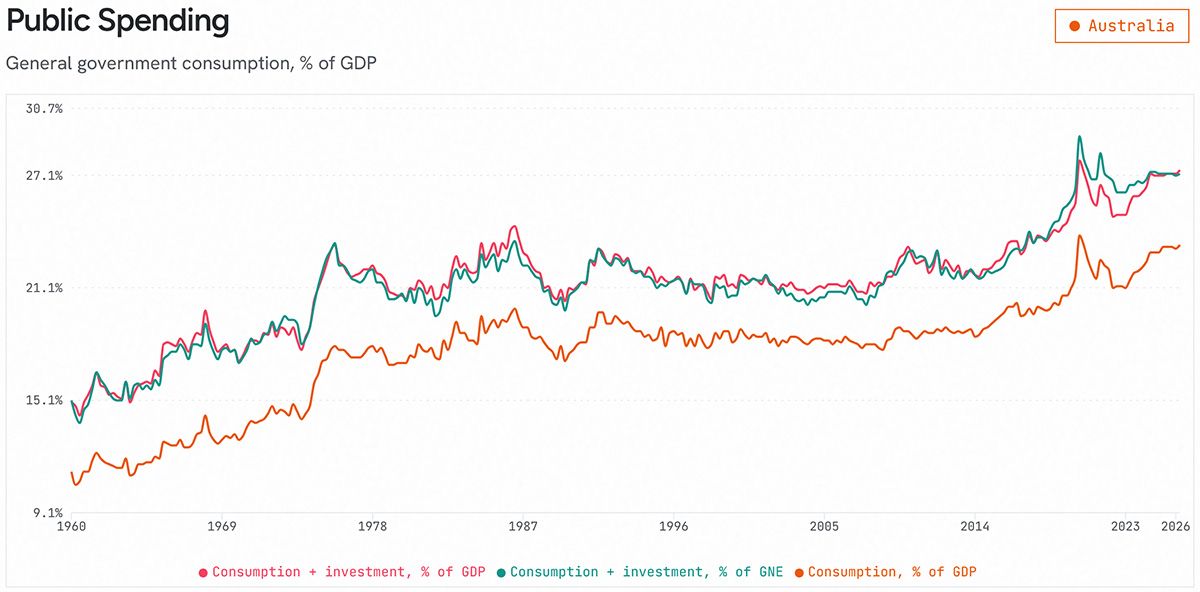
From a purely growth perspective, that much government involvement in the economy is worrying. Australia's dismal productivity numbers and jobs composition data suggest it's already suffocating the part of the economy that generates sustainable income growth.
But it's even worse from an inflationary perspective because the growth in the size of the government is being financed with new debt rather than taxes, which makes the RBA's job considerably more difficult. Worse still, once you account for the political economy, rate hikes might even be counter-productive.
In the US, some economists have started making the case that rates should be lowered, not raised. UCLA's Saki Bigio recently argued that because markets now "anticipate that future inflation will be necessary to finance the Treasury's debt", rate hikes are self-defeating. While they might provide a "temporary remission" from inflation, because they raise the interest bill on the government's debt, they also bring forward the point at which the central bank is forced to monetise it, making long-run inflation worse.
The alternative, according to Bigio is for the central bank to cut rates (John Cochrane at the Hoover Institution has expressed similar views, conditional on shortening the maturity structure of government debt first). Provided those cuts are done "while communicating that it is forced to raise its inflation target for as long as deficits last", it could discipline politicians by forcing them to own it. Why are eggs so expensive? Because we're borrowing to pay for entitlements!
Could such a strategy work? If the inflation disciplines politicians, then the modelling says yes: debt is inflated away, budget deficits come down, and inflation eventually recedes. Everyone pays off the debt through a bout of inflation rather than higher taxes (same thing, different mechanism).
But if politicians manage to out-spin the central bank and persuade voters that inflation isn't their doing, then no: you simply end up with perpetual budget deficits and an annual inflation tax in the double digits.
Australia isn't quite in US territory, yet. US government interest expenses are up to a record 18.5% of federal government revenue, versus a PBO forecast of 6.2% by 2029-30 for Australia. But with a small, trade-dependent economy, the threshold at which fiscal policy starts to dominate is likely much lower than for the issuer of the world's reserve currency.
There's no easy way out. Unless governments can rein in their spending, rate hikes are only likely to provide a temporary reprieve from the inflation tax.
About the author
Justin Pyvis
Independent economist and casual techie based in Perth, Western Australia.More →
Related
Subscribe to the newsletter.
Get new essays delivered to your inbox. No spam. Unsubscribe anytime.