

We should worry about the jobs AI won't eliminate.
I don't think AI is going to be as disruptive as a lot of the hypers and doomers believe. That's for two main reasons: large language models aren't on the fast track to artificial general intelligence, so the potential for exponential growth is limited no matter how much compute you give them; even if they did, there are far too many artificial roadblocks in modern economies that they just won't be able to break down, no matter how smart they get.
On the latter, I mean things like political lobbying, teachers unions, occupational licensing, labour regulations, inefficient taxation, local government NIMBYs, subsidies and industrial policy. Basically, anything that already stops humans from boosting productivity will also thwart humans armed with AI.
It's like the O-Ring theory, when the failure of a single small rubber O-ring brought down the Challenger space shuttle. In economic terms there are a lot of O-rings that slow all progress in given sectors. If the O-rings don't get fixed, it doesn't matter how good the rest of the parts are; they're still going to fail, or in the case of an economy, grow close to a pace that the biggest obstructions allow.
Last week one of those roadblocks, political lobbying, showed up in the robotaxi space. Uber, which once forcibly blew up an economic O-ring in the form of the taxi medallion cartel, is now trying to pull up the ladder behind it by partnering with those taxis:
"Uber is aligning itself with drivers' unions in a bid to slow the rollout of robotaxis, finding unlikely bedfellows as it faces fierce competition on self-driving technology from rivals such as Alphabet-owned Waymo.
The ride-hailing group that became notorious in its early years for skirting regulation and aggressively lobbying against worker protections has recently joined unions in pushing to limit the rollout of self-driving taxis in locations such as New Jersey and Washington DC."
That's going to happen everywhere it can in response to AI. The incumbents will always cite "safety, congestion and job impacts", as Harry Hartfield, Uber's director of AI and AV policy did. But really it's about protecting specific jobs and specific business models.
The chief economist of Sweden's blue-collar unions put it well recently when he said:
"My fear isn't that AI will eliminate jobs. My fear is the opposite: that we won't eliminate unnecessary jobs and inefficient companies quickly enough."
That's something you're not likely to hear from Sally McManus. Unlike most Australian unions, those in the Nordics tend to be more friendly to labour-saving productivity tools because they know that it raises the overall wage pot (by increasing output per worker), and that protecting workers is much more important than protecting specific jobs. They call it flexicurity, and it's how to maintain a labour force that allows for reasonably fast adjustments to changing economic conditions without throwing workers under the bus.
In the context of AI, the bigger risk for Australia is its relatively rigid labour market and too little elimination of low-value work, rather than too much. That's because any delay allows rent seekers to organise and block potential productivity improvements; just look at what's happening with data centres.
If there's something Australia desperately needs, it's productivity growth. In last week's National Accounts figures, measured labour productivity fell 0.2% over the year to June, the latest in a long run of dismal results, and the worst reading since early 2025. On a per-hour-worked basis, the Australian economy is only 1% bigger than it was a decade ago.
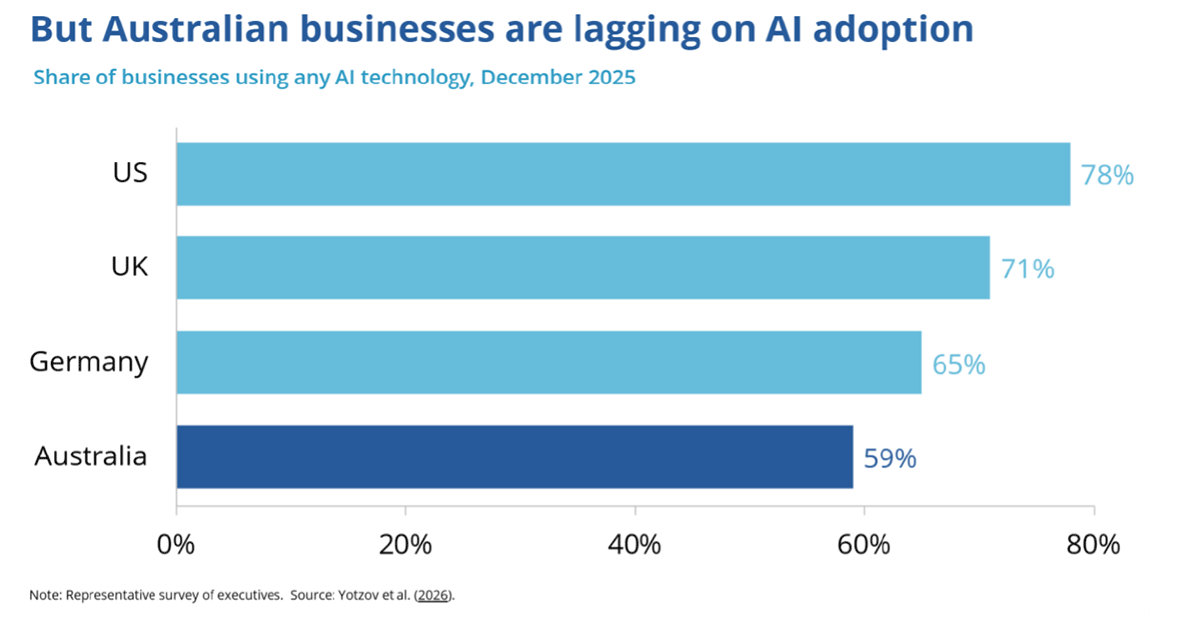
The Productivity Commission's chair Danielle Wood is right that what matters isn't just building data centres, which seems to be the Albanese government's sole focus (mainly because data centres are expected to bankroll its renewables build-out). It's about how quickly businesses adopt AI and embed it into their processes. Australia already lags the US, UK and Germany on business adoption, having "gradually slipped further behind the technology frontier".
The Uber-taxi alliance is a preview of what's to come. If given the time, every industry where AI could replace or even augment human labour, whether it's transport, legal services, or medical diagnostics, will produce its own version. Incumbents will argue for a gradual transition, for oversight requirements, or for new licensing rules, all of which will conveniently lock out potential competitors. If politicians allow or even encourage such processes to happen, many of the productivity-enhancing benefits that AI might bring will slowly fade away.
AI will eventually destroy jobs, as we know them, the same way every major technology has. But it will also create even more. From a policy perspective, you can choose to let the adjustment happen fast enough for the gains to materialise, or let incumbents slow it down until the whole thing stalls.
Australia's productivity numbers over the past decade suggest the country is already on the wrong side of that bet. Unless some of the country's many O-rings are proactively removed, AI will be just another technology incumbents managed to stall until it barely registers on the productivity scale.
Related
Subscribe to the newsletter.
Get new essays delivered to your inbox. No spam. Unsubscribe anytime.