

Responsible economic management.
Earlier this week, Australia's Treasurer Jim Chalmers released the final budget numbers for the 2025-26 financial year, showing a $6 billion improvement on what had previously been forecast. It was still an underlying deficit of $22.3 billion, and a headline deficit (which includes off-balance sheet shenanigans) of $36 billion. But Chalmers seemed thrilled, claiming that "responsible economic management is a defining feature of this Albanese Labor Government."
That's a claim that's difficult to square with the facts.
The most obvious retort is why Australia's federal government, or any Australian government for that matter, is running a deficit at all. They've been riding what Chris Richardson has described as "revenue rainbows" for years, and the latest update was no different: the $6 billion revision was due to better-than-expected tax receipts from businesses and superannuation, as well as lower welfare payments (unemployment is a relatively low 4.6%).
Meanwhile, the champion of "responsible economic management" has been cranking up public expenditure in absolute and relative terms, as tax receipts as a share of GDP reached 24.1%, a figure only 0.1% lower than the absolute peak during the naughties mining boom when the Howard government was running large surpluses. Public spending, as we know, is at its highest level as a share of the economy since the peak of the pandemic.
Only in Bizarro World is it "responsible economic management" to be spending so much that you're running a headline deficit of more than 1% of GDP in the middle of a revenue bonanza with an economy that has been relatively healthy, notwithstanding a couple of external energy shocks. As a consequence public debt is now above $1 trillion, and the PBO now expects net interest payments to surpass 1% of GDP well before 2030, surpassing the amount of funding provided to states for hospitals.
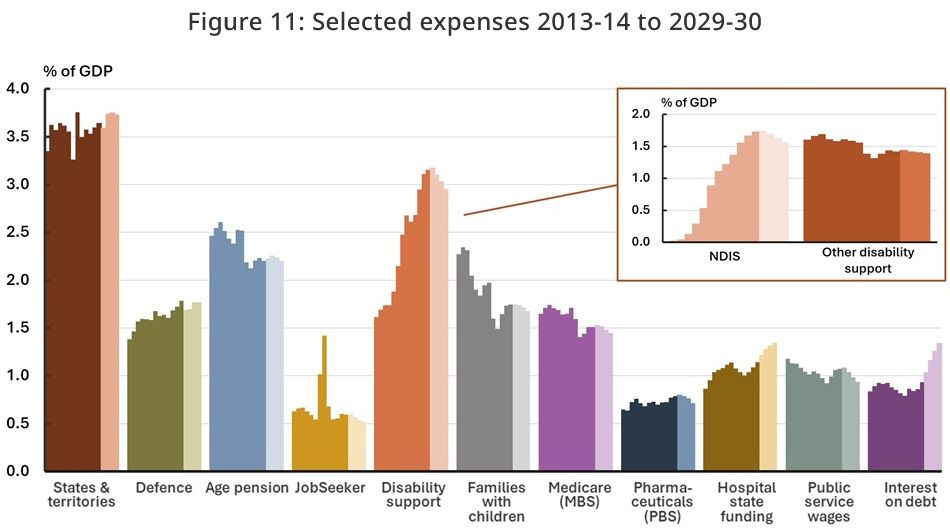
There is a cost to this profligacy, and not just in terms of the hospitals that will never be built. The RBA raised the cash rate another 25 basis points to 4.60% this week, its third increase since January and the highest in 15 years. Monetary economics is something of a dark art, but the Board stressed that growth in aggregate demand needs to stay subdued to bring inflation back to target, putting it in direct conflict with Australian governments which are still borrowing to spend. In effect, the government's sending the bill for its repeated handouts and bailouts (there was another one yesterday) directly to mortgage holders, who disproportionately bear the costs of higher interest rates.
There's also an argument that the public doesn't believe the government has a credible, long-term plan to repay the debt entirely through future budget surpluses. In that scenario, prices adjust today to reflect the expectations of future inflation to pay off the debt. That's perhaps a reason why RBA governor Michele Bullock emphasised that:
"It's critical that we stop expectations for high inflation from becoming embedded in price-setting decisions across the economy, or the problem will only get worse."
Whatever the case may be, a major cause is the Albanese government and various state governments running fiscal deficits, adding to aggregate demand and inflationary expectations, when they should be doing the opposite. The cure is higher interest rates if those higher rates force actual fiscal tightening, rather than another expansion in the deficit. If rates get high enough to cause a recession and the government simply borrows more to 'respond', we could quickly find ourselves mired in stagflation.
Another cost of the current government largess is lost flexibility. What happens if the AI boom turns to bust, and we find out that a bunch of bankers were using leverage to do naughty things, triggering another financial crisis? Australia is fortunate enough to still have some fiscal capacity to respond to double-digit unemployment, but it won't be anywhere near as much as it should be, had governments been paying off debt rather than racking it up. Revenue rainbows don't last forever.
I haven't even touched on the quality of the Albanese government's spending, which is arguably more important than the deficit itself (and it hasn't been great). But with an aging population and anti-immigration angst at all-time highs, a larger share of public funding is inevitably going to find its way into non-discretionary items such as pensions and disability support. Those are mostly transfers that have to be taxed away from the rest of the economy, which – barring an AI productivity revolution or politically challenging reform of those entitlements – will make it increasingly difficult for future governments to cut spending to rein in the debt.
Put it all together, and the Albanese government has done the Australian economy no favours, with many of the costs of its actions to be felt in the years to come. If Chalmers thinks that's "responsible economic management", then I shudder to imagine what he thinks irresponsible economic management looks like.
About the author
Justin Pyvis
Independent economist and casual techie based in Perth, Western Australia.More →
Related
Subscribe to the newsletter.
Get new essays delivered to your inbox. No spam. Unsubscribe anytime.