

Tech bros make poor economists.
Anthropic, the creator of Claude AI, published an interesting survey last week on "The AI expectations gap". Anthropic wanted to find out what its own staff and a representative sample of US adults thought AI would be capable of, and what it might do to the US economy, by 2030.
On the former, the two groups were broadly aligned: they both ranked the difficulty of eight tasks, from routine emails through to Nobel-level discoveries, almost exactly the same. But there was a huge difference in the magnitudes, with Anthropic staff believing AI will be capable of doing all tasks up to Nobel-level discoveries as soon as 2030.
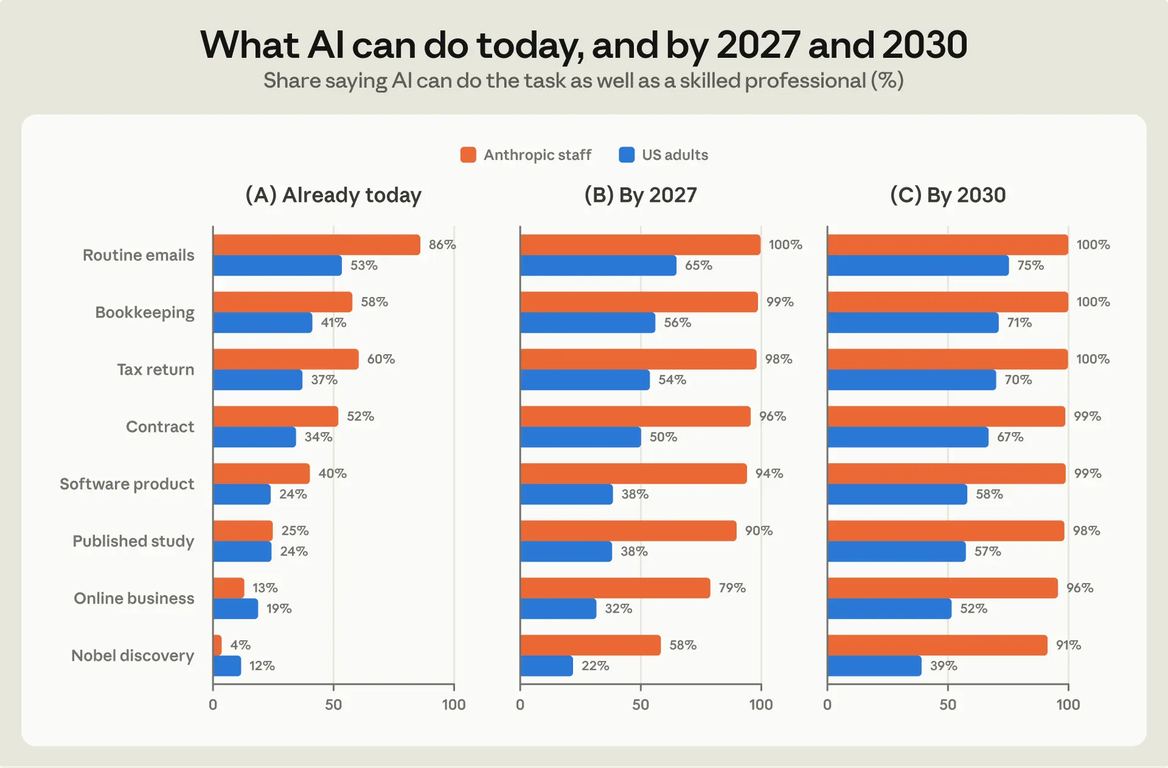
Things got curiouser when Anthropic derived an economic growth expectation from people's answers. Basically, for the Anthropic staff forecast about what AI will be doing to be true (they expect AI to be used for 65% of all tasks it could perform by 2030), annual US economic growth would have to exceed 17%. The most bullish about AI displacing their own work, i.e., those who expect AI to do 80% or more of their own work hours by 2030, forecast average US unemployment of 12.2% in 2030.
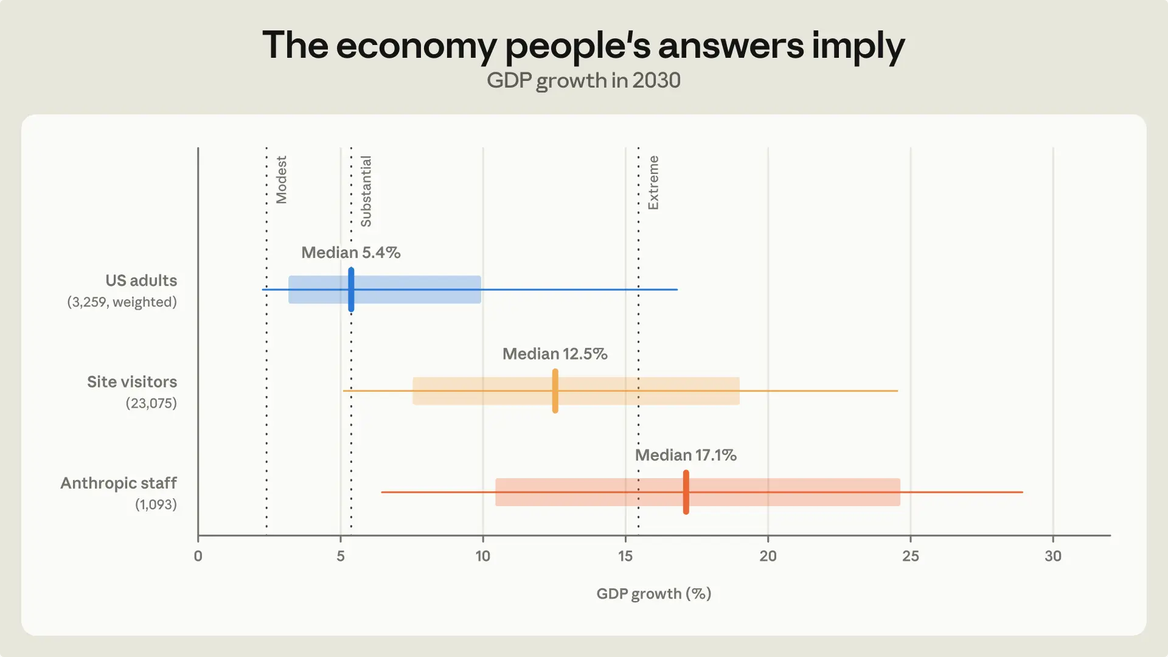
So, a rate of unemployment greater than in the Global Financial Crisis combined with a rate of economic growth with no peacetime precedent in a large advanced economy. Needless to say, I think that's completely implausible:
"I don't think AI is going to be as disruptive as a lot of the hypers and doomers believe. That's for two main reasons: large language models aren't on the fast track to artificial general intelligence, so the potential for exponential growth is limited no matter how much compute you give them; even if they did, there are far too many artificial roadblocks in modern economies that they just won't be able to break down, no matter how smart they get."
An economy where most current work is automated and unemployment reaches crisis levels cannot also be one where AI essentially unlocks all constraints on growth to enable such an outrageous rate of growth in just four years! AI might rip through certain sectors, such as coding, where there are very few human and regulatory barriers. But the entire economy? There's a reason why firemen were legally required on American diesel-electric trains for roughly three decades after steam engines were phased out!
What's most puzzling is that Anthropic staff think they alone will be immune to the carnage. In the same internal poll, 95% of staff expected their employer's headcount to grow over the next twelve months, and a quarter said it would at least double.
By comparison, the public's implied forecast of 5.4% growth by 2030 looks reasonable, but only because it's three times less delusional than the people who have an IPO to sell. Then again, people who said they used AI at work tend to land closer to Anthropic's staff expectations than the general public average, so perhaps the public's forecasting advantage may simply be that they haven't used the thing. But at least their implied forecast is plausible, even if remotely.
Look, I'm certainly AI-pilled; I use it just about every day. But I'm also an economist who knows how difficult it can be to eke out productivity in a complex economy filled with dispersed, tacit local knowledge, entrenched regulations, and special interests. My advice is not to take the economic predictions from AI tech bros seriously. They've seen what can be done by AI in a single company, extrapolated that to the entire economy, and called it macroeconomics. It's not.
Related
Subscribe to the newsletter.
Get new essays delivered to your inbox. No spam. Unsubscribe anytime.