

The enshittification of Australian credit cards.
For the past several years, I've relied on a single credit card issued by Australia's largest bank, CBA. I thought it was a good deal: no monthly fee (with a minimum spend), a decent amount of points to spend on Coles vouchers, no international currency fees when travelling, a free supplementary card, and complimentary travel insurance. The only cost I ever paid was an occasional surcharge at the till.
But on 29 September 2026, no card with that combination of features will exist in Australia. As a result, I've decided to switch to a worse deal at a different bank, because it's still better than what my old CBA card has morphed into.
So, why did CBA pull the rug out from under this specific credit card? While it's not exactly unusual for a bank to enshittify its products, in this case the bank explained its justification right at the top of the email it sent me:
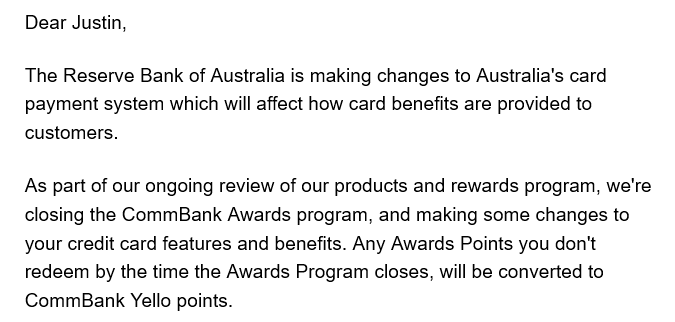
The Reserve Bank of Australia (RBA) reforms, which kick in on 1 October. Note that CBA isn't simply using the RBA reforms as a smokescreen to boost its bottom line. Every major credit card in Australia has cut its benefits or raised its annual fees over the past few weeks. HSBC, which used to offer a unique credit card that gave the holder Star Alliance Gold status, is leaving Australian retail banking altogether. Even if the reforms weren't the sole reason for its departure, they certainly gave it no reason to stay, and losing foreign competitors from a highly concentrated banking sector is rarely a win for consumers.
Now, I know some of you might think I'm overreacting; who needs a credit card, anyway? But credit cards have important uses! For example, if your credit card gets skimmed, or you're the victim of a BIN attack or card-testing fraud, it's technically the bank's money that's stolen and the damage is capped at your credit limit. With a debit card your entire balance is exposed, and your funds are effectively gone until the bank wraps up its investigation.
Then there's travel. A lot of rental car companies and hotels still require a credit pre-auth when you check in, just in case you decide to go all rock n' roll on their property. You might be able to get by with just a debit card, but it will probably involve a large cash deposit, which again deprives you of your funds for potentially weeks and puts you at the mercy of the merchant's refund process.
So why did the RBA hollow out the market for credit cards by banning surcharges and capping the interchange fees banks charge merchants? According to the Bank itself:
- Card surcharging rules were complex and confusing.
- Card payment costs were too high, especially for small businesses.
- A survey showed that 76% of consumers wanted surcharging to stop.
The first point has merit; card fees weren't baked into the sticker price, violating the Australian norm of fully inclusive retail pricing. The third point proves nothing: people will always vote against a visible fee in a survey.
But it's the second point that hits hard. Cutting the consumer credit interchange cap from 0.80% to 0.30% guts the revenue that paid for everything many Australians just lost. Banks aren't charities, so the arithmetic is simple: discontinue the product, or make it considerably worse.
Will those changes be a net benefit for consumers? The costs are clear; we've lost a bank, and products that people liked no longer exist.
As for the benefits, the interchange fee reforms did address a harm: namely that "the current cap of 0.8 per cent materially exceeds estimated eligible issuer costs on consumer credit cards". Banks were then using the gap "to fund cardholder rewards programs… encouraging consumers to use higher cost payment methods".
The RBA argued that it wanted "the costs of discretionary benefits", such as credit card rewards, to be "borne by the cardholders who choose to access them rather than being borne by merchants". But that only holds if merchants pass their savings on; the choice is still with the merchant, and if they don't fully pass it on, cardholders will pay higher prices plus be stuck with shittier credit cards, with the merchant pocketing the difference.
As for evidence, the RBA did show that high-income earners tend to hold the premium rewards cards, while low-income earners generally used EFTPOS or cash. Because payment processors push "single-rate" pricing on merchants, those costs are blended and baked into retail prices, with the cash buyer effectively funding the platinum cardholder.
But the RBA's solution ignores basic price theory. Capping interchange fees doesn't magically erase the costs of running a global payment network. Those costs have to be recouped somewhere, which is known as the waterbed effect: you push down fees in one spot, they simply pop back up in another.
There's good evidence for this from the world's largest payments market. When the US capped debit fees via the Durbin Amendment in 2011, retail prices didn't drop; merchants simply pocketed the margin. Meanwhile, the share of fee-free bank accounts fell from 61% to 28%, with monthly fees roughly doubling. One event study estimates consumers lost $22 to $25 billion in present value. In other words, the cap hurt exactly the people it was meant to protect. Cap the fee, and the product built on it dies.
The economist Thomas Sowell once observed that "There are no solutions. There are only trade-offs."
The trade-off for the RBA's interchange fee cap is the demise of the middle-class points hustle and the rise of explicit banking fees. Retailers will get a small boost to their margins, while banks will have to charge you directly for services that used to be free.
The RBA's mechanical view of markets has led it into a classic regulatory error. Price controls never eliminate costs. In this case, the RBA has simply shifted costs from banks and merchants onto consumers, with the biggest winners likely to be Coles and Woolworths, for whom the cap is pure margin (they never surcharged). Losers will be smaller merchants who will be forced to raise their menu prices rather than tack on a surcharge, cash buyers who have to pay those higher prices, and credit cardholders who will now pay for their benefits directly.
About the author
Justin Pyvis
Independent economist and casual techie based in Perth, Western Australia.More →
Related
Subscribe to the newsletter.
Get new essays delivered to your inbox. No spam. Unsubscribe anytime.